
22May2026 River Wharfe
I have just emptied the meagre catch of the evening into a woven basket and was shuffling down the narrow towpath toward my rickety little wagon when a bolt of terror seemed to strike me in the chest. It was no illusion. From the rivers thick, impenetrable mist came the same sound again not a shout but a dying gasp, a animallike horror that sent cold shivers racing up my spine. A woman was screaming. The wind howled through the ancient oaks, tearing at her voice, yet I could still make out a few desperate words. She wasnt merely calling for aid; she was pleading, pouring the last of her soul into that scream. Beside her another figure thrashed, its panicked splashes reaching the bank.
Without a seconds hesitation I flung the basket, and a handful of silverscaled minnows scattered across the damp sand. Stripping off my heavy, patched coat and the mudcaked work trousers, I was left in a threadbare shirt and plunged into the black, chilling water. The wind, like a furious beast, rose the waves, slapping foam and spray into my face.
The swim was agony. The current, usually lazy, today was treacherous and strong, clutching at my legs with cold, ropelike hands. Near the middle of the river, where the water grew especially dark and deep, a girl was frantically fighting for her life. Her dark hair floated like seaweed, sometimes soaring on the crest of a wave, sometimes sinking helplessly in the black depths that threatened to swallow her whole. The lad she had been begging for help I recognised him from the village had already reached the opposite bank. He didnt look back; his movements were sharp, frightened. He hauled a small inflatable dinghy, glanced around with a wild animals eye, then fled along the forest edge, seeking the safety of the trees.
The girls cries faded. She no longer broke the surface. When I, Victor Harper, exhausted my last strength and reached the fateful spot, only slow, ominous circles spread on the water. My heart sank to my heels. I gulped a massive breath, and dived into the icy gloom. My hands felt for a slick piece of jacket; I wrapped my arms around the limp body from behind, and with my other hand acted as an oar, kicking desperately as I tried to pull us back to shore. Each stroke burned my muscles; every gasp was a howl. Yet I kept pulling, clinging to life and to the fragile life in my arms.
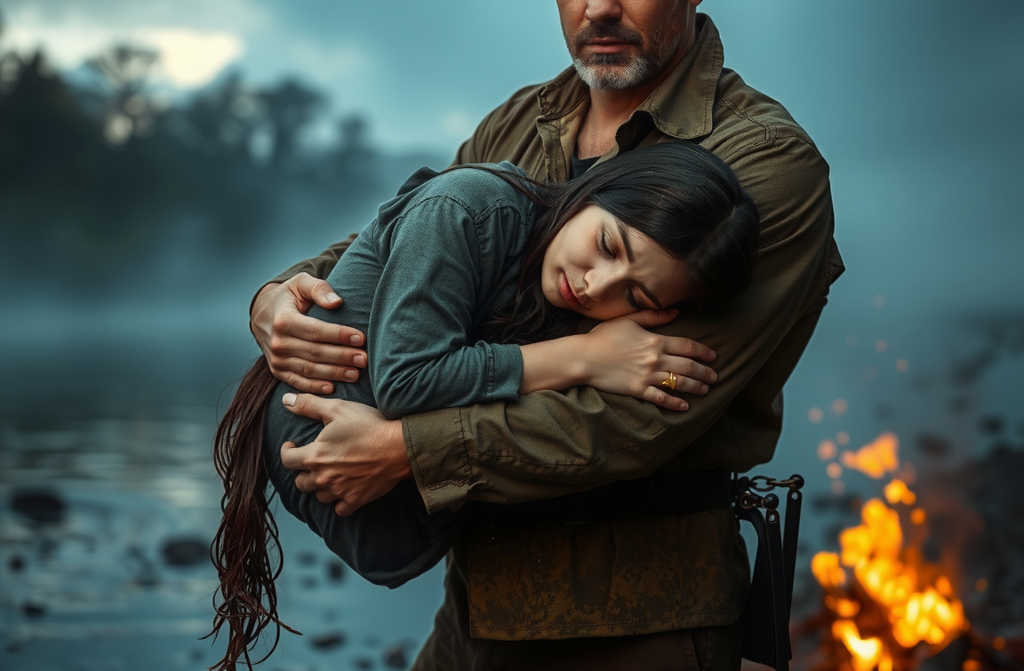
When we finally hauled the girl onto the bank, I, though drained, set to work. My hands, accustomed to hard labour, moved fast and preciserotations, compressions, artificial respiration. Murky river water poured from her lungs, and she coughed a hoarse, ragged cough. Her breathing, weak but even, returned. I needed to warm her. I gathered the dying embers of an old campfire, spread them on a bed of flat river stones, and topped the makeshift platform with a thick layer of soft pine boughs. I laid the girl gently upon it, covered her with my only jacket, still smelling of smoke and sweat. I fetched the scattered belongings, struggled to dress her shivering frame, and settled by the newly lit fire, extending my trembling, frostwhite hands toward its heat.
The warmth rose slowly, as if reluctant to penetrate the frozen flesh. The girl lay motionless; only a faint vapor from her breath marked that she was still alive. The cold water and the shock had done their work, but I knewjust as I knew every bend of this riverthat time would bring her back to consciousness. I lifted my eyes to the sky, thick with low, heavy clouds. Not even the moon could pierce that leaden veil. It was bleak and hopeless.
I stared at the flickering flames, and they pulled me back to a memory of a distant, equally grim evening that had taken everything from me.
That summer, Lily and little Arthur had come with me for a fishing trip, as we did almost every year. Leaving my wife, Emily, and our son at the caravan to sort the gear, I pushed off from the bank in my old but trusty rowing boat.
Warm up with a cuppa while Im out, love, I called cheerfully to Lily, flashing a carefree grin. Ill be back with a tidy haul and well have the best fish soup in the world!
Emily warned, Be careful, Victor. The weathers turning.
I know every stone in these waters! I shouted back, already cutting through the mirrorsmooth surface with my oars.
I dropped my lines into my favourite spot and settled into the ritual of waiting. Suddenly the sky blackened as if night had fallen early. A gale rose, bending the trees to the ground, and a wall of water crashed down. My boat was tossed, careening sideways, when a deafening crack soundedmy hull snagged on a submerged log as sharp as a dagger. Air hissed out with a nasty whine, and within seconds the boat turned into a shapeless, rubbery sack.
I tried to swim, but a searing cramp seized my leg, the icy water burning my muscles. The rivers fury overpowered me; I slammed into something hard, and darkness swallowed my consciousness. I awoke three days later on a hard, strawfilled pallet in a cottage that smelled of smoke and herbs. Rising gave me vertigo and nausea. At the door shuffled an elderly man, his face a map of deep wrinkles.
Got your senses back, he muttered, setting a steaming bowl of broth on a low stool. Drink this herbal tea; itll staunch the bleeding. Have a bite of porridge, or youll lose the breath you have left.
Where am I? I croaked, hearing a place name Id never known. A cold dread settled as I realised Id been blown dozensmaybe hundredsof miles from home.
The woods have taken you, lad, the old man said after a pause. Hunters found me halfdead. They thought youd never get out.
I tried to sit up again, but he waved a withered finger:
Lie still, dont be a hero. Youve lost bloodmuch. Keep to yourself now; moving will only bring death. Rest.
What about my family? My voice cracked with desperation. I imagined Lilys anguish, my heart tightening in a painful knot.
This isnt a post office town. Its just forest, wolves howling, bears growling. No one brings letters here.
I asked how he survived.
Berries, mushrooms, nuts, herbs. In winter we store what we can. Hunters come by now and then with a few provisions. He sighed heavily, climbed onto his pallet, and whispered, Sleep. You need strength.
He soon fell into a deep snore. I stared at the dim firelight, its shadows dancing on the walls, and glimpsed the faces of Emily and Arthur in the flickering shapes. The longing was so sharp I clenched my teeth to keep from sobbing. Outside, a blizzard wailed, swallowing all paths and hopes.
Days passed, each one blending into the next like knots in a rope. Every tiny movementturning my head, sitting up, lifting a spoonfelt like a small victory, a spark of joy.
At last I could stand, though the old mans prophecy lingered. When I finally stepped beyond the cottages door, the world was a blinding white, a pristine blanket of snow.
How do I get out of here? I asked the hermit, trying to keep despair out of my voice.
Not possible, he replied bluntly. You cant walk yet, and the road is a days trek at best, if not more. The tracks are buried. Youll have to stay until spring. If you regain strength, Ill guide you.
What about hunters? Can they help?
Hunters are out in other fields during winter. They come in spring and autumn. Maybe someone will take you in if luck smiles, but the places are now impassable. He shook his head and fed another log to the fire.
The memory of the river surged again, and my heart pounded with that old, familiar ache. I fed the fire with dry twigs, rose, and approached the girl. Her breathing deepened, steadier, though her mind was still foggy. I adjusted my jacket over her and returned to the fire, letting the past try once more to drag me into its relentless whirl
The hermit was a man of few words. When I grew strong enough to move about the cottage, he began to help: clearing snow from the doorway, fetching firewood, stoking the stove. The porridge of strange roots and herbs I now ate without revulsionhunger and survival instinct outweighed any disgust. The tea he brewed from summergathered herbs reminded me of Lily, who always added mint and sage to her brew. Those memories were both sweet and bitter, like a wound that never quite healed.
Winter stretched on endlessly, as if time itself were caught in an icy trap. When spring finally crept in, the snow melted reluctantly, surrendering the earth inch by inch. Two more months of a bruising battle between winter and spring passed, and when I felt strength return to my legs, the hermit fell ill.
I wont be able to see you off as promised, he rasped, lying on his pallet. Im lying here now. I helped you up, now I must look after myself.
How will you survive alone? Ill take you to the town, to doctors!
There are no doctors who could fix you like that, he waved feebly. All they know is cutting. Weve kept gangrene at bay with bandages and herbs. Go on. Ill pull throughmaybe not right away.
He gave me directions, and I, grateful beyond words, set off. The road, which in my mind seemed straight, soon turned into a chaotic maze. I walked until darkness fell, never finding a clear path. I spent the night under the pine boughs, waking to a soft rustle behind me. Turning, I saw a few glowing green eyes in the gloomwolves. Without hesitation I scrambled up the nearest tall oak, clinging to its bark until dawn. The pack, sensing futility, slipped away deeper into the night. Descending felt like courting death.
Morning found me crawling again, hope all but gone. Days blurred into weeks. Encounters with a boar, a lynx perched on a branch, and nights perched in trees became routine. I survived on wild berries, roots, fresh water from forest streams, and the occasional scavenged scrap. Giving up was never an option; I had to reach home, alive.
Two weeks later I stumbled upon a dark rectangle among the treesa derelict shepherds hut. I dragged myself inside, nearly collapsing from exhaustion. Relief washed over me, almost painful. It was an old hunting shelter, its rusted door barely moving, long abandoned. Inside lay dust, dry pine needles, and the faint smell of mice. A single grimy window showed a battered cot with a thin mattress, a rolled sheepskin, a sack of salt, a matchbox, a halffilled sack of oats, and a tin mug.
Outside I gathered brush and, finding a small clearing, built a fire. I boiled water from a nearby stream in a tin, steeped the dried leaves of blackcurrant and mint Id found in the hut. The first sip of the hot, fragrant drink made me feel almost joyous. I slammed the door shut, barricaded it with a stout stick, and curled up in the dry sheepskin.
Sleep claimed me like a death. I awoke to the roar of a bear nearby. Fear gripped me, but the sturdy larch walls gave me a sliver of courage.
What to do next? Wandering a foreign forest felt like suicide. The hut offered shelter, some food, and relative safety. I decided to stay, to wait out the worst and hope for rescue later rather than perish wandering.
Matches were scarce, so I learned to strike fire with flint, dried mushrooms and berries over the stove, and collected medicinal herbs, recalling the old mans lessons. Weeks turned into a month, perhaps more. At dawn distant gunshots and barking dogs shattered the silence. I burst from the hut in my threadbare shirt, sprinting toward the sounds, shouting hoarsely and stumbling over roots.
Voices answered. After what felt like an eternity, four hunters emerged from the trees, having tracked me by chance. They led me back to civilization. The journey to my hometown took more than a day on borrowed rides, my hands clenched tight around the memory of the rivers roar. I finally stood before the familiar door of the flat I once shared with Emily and Arthur. My heart hammered as I knocked. A man in a stretchedout home Tshirt opened.
He told me the previous tenants had moved out months ago after the husband drowned. The word struck like a verdict, a heavy hammer on my skull. So Lily thinks Im dead I thought.
I wandered aimlessly, ending up at the local police station. Stammering, I explained my plight. An officer took my statement, shrugged, and said theyd file a missingperson report.
Help me find my family! They think Im gone! I pleaded.
They asked for all detailsnames, addresses, relatives. Promises were made. I later visited the warehouse where I had worked as a stock clerk. The gates were locked, a new logo hung over the entrance.
Theyve moved, the caretaker said, sweeping rubbish. To a new address. I dont know where.
The city, during my absence, had become strange and indifferent. My last hope lay with my childhood friend, Sam. I rushed to his flat, only to be met by my exwife, Natalie. Her face hardened.
Were divorced. He went off with someone else in another town. Ive heard nothing about Lily.
A couple of old mates offered small sums, but none could house me. Lily had been a quiet woman, a talented knitter who sold exquisite sweaters and hats, but I never knew her clients.
The police dragged their feet, their answers looping like a broken record: Were still searching. No results yet. After a month I secured a temporary ID and began hunting for any work. Men in overalls gathered by the old bridge, waiting for a truck. I lingered on the edge.
Soon a battered pickup rumbled up. A headscarfed driver stuck his head out:
Got any laborers? Three of em! He jabbed his fingers at a few men, who leapt into the back and the vehicle roared away.
Another driver offered a job with board. I, seeing a fellow weatherbeaten stranger, took it. We drove to a derelict industrial site on the outskirts of town, a massive halfcollapsed warehouse reeking of chemicals, cheap booze, and mould.
The work was simple and disgusting: pumping a foulsmelling liquid from barrels into bottles, capping them, slapping on fake labels, and packing crates. We slept on the crates. Food came once a weekbread, pasta, tinned stew. New barrels arrived twice a week; finished crates were taken away.
A month passed without any word on wages. When I asked, the foreman growled, First you work for food and a roof, then well talk. They took my passport for registration. They refused to return it. When I tried to leave one evening, two burly guards blocked me, stating plainly that walking out without documents was a terrible idea.
Time stretched. A year and a half in that grim prison eroded everything from me except one thingmy will to get out. I escaped with a few hundred pounds Id managed to scrape from handling the rations.
Back at the police, I filed a complaint about the illegal detention and extortion. It took half a year before a new passport was finally issued. An officer, dry as ever, warned, Next time think carefully before you file a report. Your storys a mess; you could end up in jail for false accusations.
I went to old acquaintances asking for a wash or a spare coat. Everyone politely declined. Doors shut one after another.
Despair became my constant companion. I drifted to a suburban estate, offering any kind of manual labourdigging gardens, fixing fences, chopping woodfor a meal, a bath, or a pair of sturdy trousers.
Some slammed the door in my face. Others were kind. An elderly pensioner fed me soup, let me use her sauna, and gave me a pair of warm trousers and a heavy coat. Another gardener, seeing my determination, slipped me a few pounds. Slowly I gathered a few sets of clothes and a modest sum. I placed an advertisement on the local radio, searching for my family. The broadcast aired, but no calls came.
Running out of urban options, I made a decision. I returned to the riverbank where the tragedy had begun, found an old, rusted railway carriage left by some longgone surveyors. I repaired it, sealed the cracks, built a makeshift stove, and began a solitary existence. Years slipped by, and one night, far beyond the years I thought Id live, I heard a familiar cry for help rising from the water.
I raced to the edge, heart pounding. The girl I had saved lay on a makeshift stretcher, eyes opening slowly, confusion giving way to awareness. Relief flooded me, and I looked toward the opposite bank, where faint lanterns flickered and voices carried across the water.
It must beAnd as the rescue boat pulled us to safety, I finally understood that the river had given me both loss and redemption.