
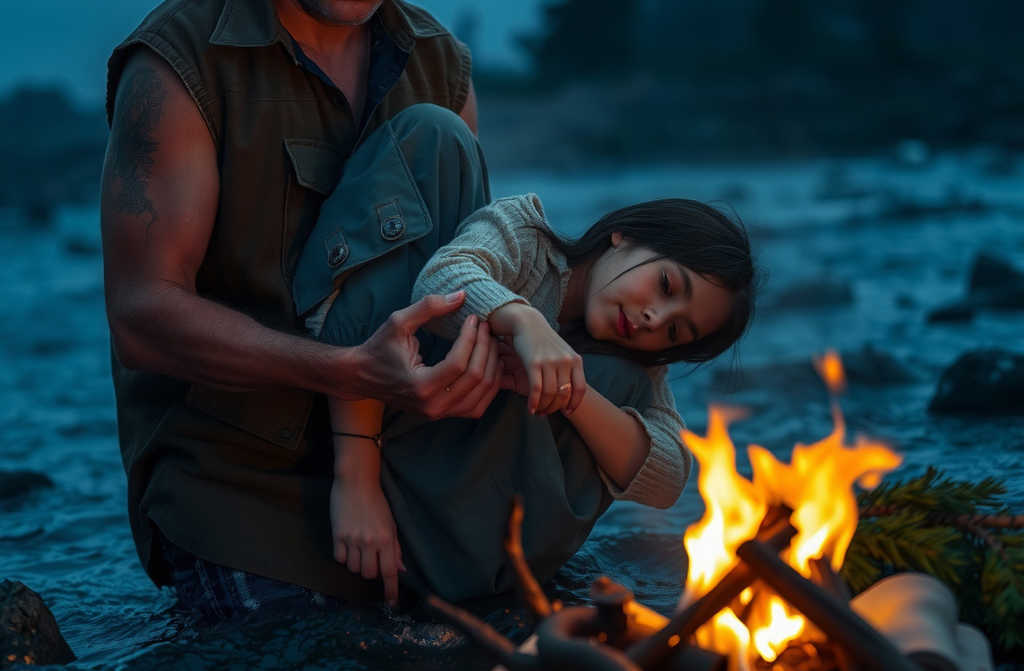
Victor Hargreaves, his modest evening catch already tucked into a wicker basket, trudged down the narrow footpath toward his rickety wagon when a bolt of terror seemed to strike him midstep. It wasnt a trick of the light. From the rivers thick, impenetrable mist a low, dying wail rose againan animallike scream that sent a shiver racing up his spine. A womans voice cut through the gusts that rattled the ancient pine crowns, her cries shredded by the wind yet still discernible. She wasnt merely calling for aid; she was pleading, pouring the last of her soul into every desperate syllable. Beside her another frantic splash echoed from the bank.
Without a moments hesitation Victor flung the basket aside; a handful of silverscaled fish scattered over the wet sand. Shedding his heavy, patched coat and battered work trousers, he hurled his threadbare shirt aside and plunged into the black, chilling water. The wind, a feral beast, whipped the waves into a frothing barrage that slapped his face with spray.
The swim was a torment. The river, usually lazy, now surged with a treacherous, icy grip that clutched at his legs like cold fingers. Near the channels deepest throat, where darkness pooled the thickest, a girl thrashed hopelessly. Her dark hair floated like seaweed, sometimes surfacing on the crest of a wave, then plunging back into the abyss that threatened to swallow her whole. Victor, the very man she had been beggingfutilelyto rescue, had already reached the opposite bank. He did not look back; his movements were sharp, panicked. Dragging a small inflatable boat, he stared across the water with the wild eyes of a hunted animal, then fled along the forests edge, desperate to lose himself in its shelter.
The girls cries faded. She no longer broke the surface. When Victor, exhausted to the brink, arrived at the fatal spot, the water rippled only in slow, ominous circles. His heart sank to his feet. He gulped a massive breath, plunged into the icy gloom, and felt his hand close around a slick jacket sleeve. He hauled the limp body up from behind, using his other arm as a makeshift oar, kicking furiously toward his own shore. Every stroke burned his muscles; each gasp was a hollow moan. Yet he rowed, clinging to life and to the fragile life in his grasp.
He hauled the girl onto the bank, his own fatigue forgotten, and set to work. Hands hardened by years of labor moved with practiced speedpressing, turning, performing mouthtomouth. Cloudy river water burst from her lungs as she coughed a ragged, broken laugh. Her breathing steadied, weak but even. First he needed to warm her. He gathered the dying embers of an old campfire, built a platform of flat river stones, and layered it with a thick blanket of pine boughs. He laid the girl gently on this makeshift cot, covered her with his only jacketstill smelling of smoke and sweatthen gathered his scattered belongings, wrung the damp clothes onto her chilled frame, and seated himself by the rekindled fire, extending trembling, frostwhite hands toward the flames.
Warmth crept in slowly, as if reluctant to penetrate frozen flesh. The girl lay motionless; only a faint mist from her breath testified that she clung to life. The cold water and the shock had done their work, but Victor knewjust as he knew every bend of this riverthat time would bring her back. He felt that certainty as deeply as the rivers current.
He lifted his gaze to a sky smothered in low, heavy clouds. No stars could pierce the leaden veil; even the moon was a hidden promise. The world felt empty, hopeless.
His eyes fell on the fires tongues, and they dragged him back to a memorya bleak, merciless evening that had robbed him of everything.
He, Emily, and little Arthur had set out for a weekend of fishing, as they did almost every summer. After leaving his wife and son to sort their gear in the caravan, Victor pushed off from the bank in his old but trustworthy rowboat.
Warm yourselves with a cup of tea, Ill be back with a good haul, and well have the finest fish soup in the country! he called cheerfully to Emily, his face lit by a carefree grin.
Just be careful, Victor. The weathers turning, Emily warned, eyes tracking the gathering clouds.
Dont worry I know every stone out here! he shouted back, oars slicing the glassy surface.
He arrived at his favourite fishing spot, cast his lines, and sank into his ritual of patient waiting. Suddenly the sky blackened as if night had fallen in midday. A gale rose, bending the ancient oaks to the ground, and a wall of water surged from the heavens. The boat capsized, careening sideways, when a deafening crack echoedthe hull snagged a submerged log that jutted like a dagger. Air hissed out with a bitter whine, and in an instant the boat disintegrated into a shapeless slab of soaked canvas.
Victor tried to swim, but a searing cramp seized his leg, the icy water biting his flesh. The rivers fury overpowered him; it slammed him against a hidden rock, and darkness swallowed his consciousness. He awoke three days later on a rough wooden bunk in a thatched cottage smelling of smoke and herbs. Rising made him dizzy, nausea clawed his throat. At the doorway shuffled an ancient man, his face a map of wrinkles.
Got up, have you? the old man muttered, placing a steaming bowl of broth on a low stool. Drink this tea; the herbs will staunch your bleeding. Eat the porridge, or you wont have the strength to live another day.
Where am I? Victor croaked. The name of an unfamiliar shire slipped from the old mans lips, and Victor realised with dread that hed been carried dozensperhaps hundredsof kilometres from home.
Youve been lucky, lad, the old man said after a pause. Some hunters dragged you here barely alive. Thought youd never make it.
Victor tried to rise again, but the old man waved a withered finger at him.
Stay down, dont be a hero. Youve lost too much blood; youll only die if you push yourself. Rest and heal.
What about my family? My wife, my son they dont know Im alive! Victors voice cracked with desperation. He imagined Emilys anguish, his heart tightening into a painful knot.
What news can I give you? the old man sneered. This isnt a post office town. Its just woodswolves howl, bears roar. No one comes here except hunters now and then, bringing a few supplies.
How do you survive out here? Victor asked, genuine puzzlement in his tone.
The usualherbs, mushrooms, nuts, berries. In winter we stockpile. Occasionally a hunter swings by with a few provisions. Thats how Ive survived twenty years. The old man sighed heavily, then, limping, crawled back onto his bunk. Sleep. You need strength.
He soon fell into a restless sleep, while Victor stared at the dim flame dancing in the iron pot. Shadows flickered on the walls, forming the faces of Emily and Arthur, a grief so sharp he clenched his teeth to keep from howling. Outside, the wind howled like a beast, shredding every hope.
Days merged into one another, each tiny movementturning his head, sitting up, lifting a spoonfelt like a hardwon victory, a sliver of joy.
At last Victor could stand, though still unsteady, just as the old man had predicted. He stepped out onto the snowcovered world; everything was a blinding white, untouched blanket of winter.
How do I get out of here? Victor asked the old man, trying to hide his desperation.
Theres no way. You cant walk, and the road is a days trek at best. Snow has covered all the tracks. Youll have to wait till spring. If you recover, Ill guide you.
What about the hunters? Can they help?
Hunters spend winter elsewhere. They come in spring and autumn. Maybe someone will take you in if luck smiles, but the woods are now impassable. The old man shook his head, feeding another log to the fire.
Victor shivered, the memory of the rivers roar pulling him back. His heart pounded with an old, familiar ache. He stoked the fire, hauled a few dry branches, and returned to the girls side. Her breathing grew deeper, steadier, though her mind was still adrift. He adjusted her jacket, then retreated to the fire, allowing the past to drag him once more into its relentless whirl
The old man remained silent. When Victor regained enough strength to move around the cottage, the old man began to help: clearing snow from the doorway, fetching firewood, tending the stove. He ate the bland porridge made from unknown roots without revulsionhunger and survival instinct outweighing disgust. The tea the old man brewed from summergathered herbs reminded Victor of Emily, who always added mint and thyme to her brew. Those memories tasted both sweet and bitter, like a wound that never fully heals.
Winter stretched on forever, as if time itself were frozen in ice. When spring finally arrived, the snow melted grudgingly, inch by inch. Two more months of a bruising battle between frost and thaw passed before Victor felt strength return to his legs. The old man, now frail, whispered:
I wont be able to take you where we promised. Im on my deathbed. I lifted you, now I must tend to myself.
How will you manage alone? Ill take you to the town, to doctors, to a hospital!
The doctors there could never mend you like this, the old man rasped. All they know is cutting. Weve healed our own gangrene with herbs and bandages. Go. Ill get better in time. Not the first time.
He pointed the way, and Victor, grateful beyond words, set off. The route that had seemed straightforward on a map dissolved into a chaotic maze within hours. He walked into darkness, finding no trail. Night fell; he slept beneath the pine needles. He awoke to a soft rustle behind him. Turning, icecold terror gripped him as he saw, halflit, two pairs of glowing green eyeswolves. Without hesitation, the youthful skills hed learned long ago surged; he scrambled up the nearest tall oak, clinging to its rough bark until dawn, nails digging into the wood as the pack, sensing futility, slipped away into the deep woods. Descending felt like courting death.
Morning found him on the road again, hope dwindling. Days passed in a blur of encountersa boar charging through the brush, a lynx perched on a branch, nights spent perched in trees for safety. He survived on wild berries, roots, and the occasional springfed stream, sleeping in short, vigilant bursts. Yet surrender never entered his mind; he had to reach his family alive.
Two weeks turned into endless wandering across the merciless forest, days and nights indistinguishable.
At last, a clearing revealed a dark rectangle: a derelict cottage. He crawled toward it, nearly collapsing from exhaustion, and felt a surge of almostpainful relief. The doors rusty latch gave after a hard push; inside lay dust, dry pine needles, and the faint scent of mouse. A lone, grimy window illuminated a battered cot with a thin mattress and a rolled sheepskin. On a low table rested a sack of salt, a box of matches, a halffilled sack of grain, and a tin mug.
Victor stepped outside, gathered firewood, and built a blaze in a small clearing nearby. He boiled water from a nearby stream in a tin can, steeped dried currant leaves and mint hed scavenged from the cottage. The first sip of the hot, fragrant drink lifted his spirits almost to joy. He barricaded the door with a sturdy branch, then curled into the dry sheepskin, finally surrendering to sleep.
A bears roar shook the night, but the sturdy larch walls gave him a sliver of confidence. He didnt know what to do next; staying meant safety, leaving meant certain death. He chose to stay, to wait for rescue. He learned to strike sparks with flint, dry mushrooms and berries over the fire, and collect medicinal herbs, recalling the old mans lessons.
Weeks turned into a month, perhaps longer. One dawn, distant gunshots and barking dogs pierced the silence. Victor leapt from the cottage in his thin shirt, stumbling toward the sounds, his throat raw from shouting.
Someone answered. After a long, tense interval, voices grew clearer, accompanied by the crackle of branches underfoot. Four hunters, lost by chance, emerged from the trees. Victors heart hammered as he finally found a way out.
He boarded a passing lorry, then a minibus, traveling over a day to the nearest town, barely sleeping, hands clenched in anxious fists. He arrived at a modest flat he once shared, his pulse thudding as he knocked. The door opened to a man in a loose Tshirt.
The current tenants been here three months, the man said, the previous family left soon after the husband drowned.
Drowned, the word hit Victor like a hammer. So Emily thinks Im dead
He felt his world tilt. He fled the flat, wandering aimlessly until he stumbled into the local police station. Stammering, he recounted his tale. The officer scribbled his detailswife, son, friendspromising to search.
Later, he visited his old warehouse job; the gates were locked behind a new corporate logo. A caretaker shrugged, They moved to a new address. I dont know where.
The city felt foreign, indifferent. His last hope lay with his childhood friend, Simon. He rushed to Simons house; the door swung open to reveal his exwife, Natalie, whose face hardened.
Were divorced, she said coldly. He left for a new life elsewhere. I know nothing about Emily.
Other acquaintances offered scraps of cash, a spare coat, a place to sleep for a night, but no lasting help. Emily, a quiet woman who had worked from home knitting exquisite sweaters and hats, had no friends shed ever mentioned. Victor had never known her clients.
The police dragged their feet; each visit returned the same tired refrain: Were still looking; no results yet. He finally obtained a temporary ID card and scoured the streets for work. Near the old bridge, men in overalls waited for a delivery truck. Victor approached, was ushered onto a battered lorry. The driver shouted, Need hands for a demolition site! Three of you! Victor, seeing a fellow weatherworn stranger, seized the chance.
They drove to a derelict industrial estate on the outskirts, where a massive, halfcollapsed warehouse reeked of chemicals, cheap spirit, and mould. The job was menial and filthy: siphoning a stenchfilled oil from drums into barrels, capping them, slapping fake labels on boxes, and stacking pallets. They slept on those pallets. Rations arrived weeklybread, pasta, tinned stew. New drums came twice a week, empty ones taken away. No salary was spoken of; questions were met with a grunt: Work first, pay later. Their passports were confiscated for processing. When Victor tried to leave one night, two burly guards blocked him, warning that abandoning the site without documents would bring trouble.
Months dragged into a year. Victors spirit eroded, yet a stubborn spark of freedom remained. He eventually escaped, pockets holding only a few hundred pounds earned from loading the stew. He reported the exploitation to the police; the case lingered for half a year. When a new passport finally arrived, the officer dryly warned, Next time, think twice about the claims you make. Your story looks messy. You could end up convicted for false reporting.
Victor begged former acquaintances for a wash, a change of clothes; each turned him away. Desperation became his only companion. He drifted to a suburban caravan park, knocking on gates, offering to dig gardens, fix fences, haul wood in exchange for a meal, a bath, a piece of clothing. Some slammed doors; a pensioner woman fed him soup, let him bathe, handed him sturdy trousers and a coat. Another resident paid him a few pounds for his hard work. Slowly, Victor accumulated a few sets of clothing and a small sum. He placed an appeal on the local radio for his family, but the airwaves returned silence.
At last, exhausted of city hopes, he returned to the woods. On the same riverbank where his nightmare began, he found an old, rusted railway carriage abandoned by quarry workers. He repaired it, sealed the gaps, fashioned a makeshift stove. Thus began his solitary new life, one he eventually learned to accept.
Years later, the rivers cry rose again.
Victor, now a weatherbeaten man, heard a womans scream for help. He sprang to his feet, raced to the waters edge. The girl opened her eyes, bewildered but conscious. Relief flooded Victors chest; his gaze drifted to the opposite bank where distant lanterns flickered and voices called.
It must be for us, he whispered to her, voice trembling with sudden hope. Help me gather dry wood for a signal fire.
Together they stacked twigs near the waters edge, ignited them with his campfires ember. Flames leapt high, lighting the night and the rivers surface. Soon a rubber rescue boat glided toward them, accompanied by a young man who had once fled the forest.
Arthur! the girl called weakly, and Victors heart thudded with a strange, uneasy rhythm. The name rang unfamiliar.
The young man, flushed with shame and gratitude, approached and extended a hand.
Victor lifted Arthur into his arms, tears mingling with the river’s chill, and finally felt that after all the wandering, he had come home.