
April 14, 2023
Dear Diary,
This afternoon the nurses were buzzing about the new patient in WardB. Did you see the old lady, the one they just admitted? whispered one, eyes darting toward the curtained bed. She looks as grey as the English sky in November.
Yes, replied another, she must be in her late seventies. Probably widowed, with a few grandchildren roaming about.
I reckon her husband must have been a good sort, but Ive never seen her speak to anyone, the third added, folding her hands. We call her Annabelle, though Im not sure if thats her proper name.
Soon after, the murmurs faded as a young mother stepped out for a quick breath of fresh air, leaving the ward to its own quiet drama.
Annabelles story has always been a hard one. When my sister, Emily, was just four, a typhoid outbreak swept through our village. Her mother, father, infant brother and even her grandfather fell ill and never recovered. From that day onward, Emily was raised by my own mother, Martha, a stern, ironfisted widow who never knew the softness of affection.
Fast forward to 1941. Emily, then thirteen, and my brother Victor, also thirteen, were living in neighbouring hamlets on the outskirts of Leeds. Both of us left the farms to work at the steelworks in the town centre; labour was scarce, and the mill needed as many strong hands as it could find. We lived in the same row of terraced houses the mill built for its workers, and thats where we first met. From those early days we toiled side by side, keeping pace with the older lads.
When Victor turned fifteen, the war called. He signed up for the Home Guard, eager to defend the country. I wanted to join him, but the recruitment officer sent me back to the factory, insisting the production line needed me more than the front lines needed another riflehand.
At eighteen, Victor and Emily exchanged vows in a modest chapel. There was no grand reception the country was still reeling from the aftermath of the war, and celebration felt frivolous. Emilys grandmother, Martha, disapproved of the marriage and urged them to move into a cottage of their own, even though their families were thirty miles apart.
A year later their son, William, was born. The couple were over the moon, their home filled with a brief, tender peace. Yet life, as it often does, proved fleeting.
When William turned six, Emily and Victor still lived as a unit, the envy of the whole parish. Victor earned a reputation as the best chimney sweep for miles around; his chimneys were the talk of the county. One bitter January, the parish council asked him to repair a furnace in a neighbouring village across the River Aire. He took William with him because Emily was working the night shift. The river was frozen solid, and the wind howled like a pack of wolves.
Victor hauled a heavy toolbox, refusing to use anyone elses tools a principle he never swayed from. William, full of youthful energy, ignored his fathers pleas to stay close. Just twenty metres from the far bank, the boy slipped into a thin sheet of ice, disappearing into a snowcovered pool. Victor lunged to pull him out, but
By the time I heard the tale, Annabelle was already greyhaired at twentyfive, having lost both her husband and her own son years before. The weight of that house, every corner echoing their absence, became too much for Emily. She fled back to her native village, returning to Marthas roof.
Emily shut herself away, the colour draining from her days. She no longer entertained thoughts of a new family. Yet, at fortythree, she decided to try again, aware of the hardships that awaited but terrified of a solitary fate even more.
The village where she lived was hard to reach, nestled among rolling hills far from the nearest town. When the bitter cold set in, she arrived at the hospital early, fearing that help might be delayed. She worried constantly about her child’s health; age, after all, is a relentless overseer.
From the moment she entered the ward, Emily seemed a ghost wandering the corridors. Eighteen years ago she had lost both her husband and son; time had not soothed the wound, nor had it dulled the ache.
Now, Emily is a mother again a healthy baby boy she named Daniel. She never forgot Williams wistful wish:
Buy me a little brother, he had said. Dad made me so many toys! Ill play with my brother.
What shall we call him? their father had asked.
Daniel, Emily replied.
Then Daniel it shall be! Victor beamed, exchanging a look of silent understanding with Emily.
At first, they kept the news from Williams memory, fearing that telling him would reopen old scars. When the tragedy struck and both husband and son were gone, Emilys grief had been so raw she could not bear another loss. Now, with Daniel in her arms, she feels a fragile hope returning.
Martha greeted Emily at the hospital with a scowl.
Whats this now, youre crying again, my dear? she rasped, voice creaking like an old wooden gate. Everyone in the village must be gossiping about your disgrace.
I havent shown my face to the street for a week, Emily murmured, and now theyll all ask: has my old mind finally slipped?
The villagers did chatter, of course. Nothing stirs a rural community more than a fortythreeyearold spinster bearing a newborn. Marthas criticism cut deep, yet within a year the old womans health failed, and she passed away peacefully.
Despite everything, I cannot deny that Martha raised Emily with a sturdy backbone. Daniel grew into a handsome young man, tall, darkhaired, with a steady gaze, nothing like his mothers fiery red locks but beloved all the same.
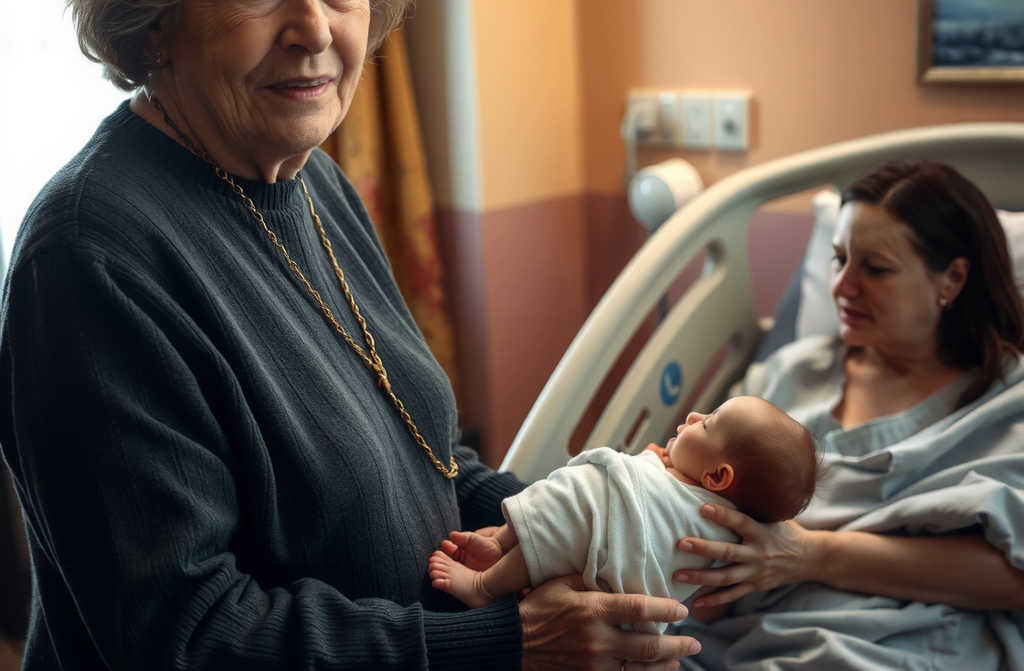
At seventy, Emily watched Daniel, now a father himself, rush into the hospital to see his newborn daughter. His wife, Susan, lay on the first floor, cradling the infant.
Susan! Susan! Show us the baby! Daniel shouted, eyes bright with tears.
Susan lifted the tiny bundle, and Daniel whispered, Look, Mum, shes a redhead! Just like you.
Seeing his mothers smile, I felt a wave of gratitude. Life, with all its cruelties, had somehow come full circle.
I close this entry with a thought that has settled in my heart over the years: grief may linger, but it does not have to imprison us forever. The willingness to love again, even after the deepest loss, is what keeps us human.
**Lesson:** Even when the world seems to have ripped us apart, the courage to open our hearts anew is the only true path to healing.