
14October2026
I have barely managed to haul my meagre evening catch into the wicker basket before the narrow track that leads back to my rickety goods wagon. I stopped dead in my tracks, as if a bolt of lightning had struck me. It wasnt a trick of the mind. From the rivers thick, impenetrable mist came the same sound againa dying wail, a guttural moan that lodged a cold, animal terror deep in my spine. A woman was screaming. The wind howled through the ancient pine crowns, tearing and scattering the timbre of her voice, yet I could still make out a few desperate words. She wasnt merely calling for help; she was pleading, pouring every last ounce of her soul into that cry. Beside her, another voice splintered the night, a frantic splash of water reaching the bank.
Without a second thought, I hurled the basket. A handful of silvery fish flopped onto the damp sand. Stripping off my heavy, patched coat and the mudcaked work trousers, I was left in a threadbare shirt and plunged into the black, chilling water. The wind, like a wild beast, raised the waves, slapping foam and spray across my face.
Rowing was a battle of its own. The current, usually a lazy companion, was today treacherous and strong, its cold fingers clawing at my legs. Near the rivers deep channel, where the water turned almost black, a girl thrashed desperately. Her dark hair, like seaweed, rose on the crest of each wave, then sank helplessly into the abyss, pulling her under. She seemed to be begging for aid from a young man who had already reached the opposite bank. He did not look back; his movements were sharp, frightened. Grabbing a small inflatable boat, he glanced around with the wild eyes of a hunted animal, then retreated along the forest edge, eager to disappear into the thicket that might shelter him.
The girls cries faded. She no longer broke the surface. When I, Victor Ives, finally mustered the last of my strength and reached the fatal spot, only slow, ominous circles rippled away on the water. My heart sank to my heels. Taking a deep lungful of air, I dove into the icy gloom. My hands found the slick sleeve of my coat; I wrapped my arm around the limp body from behind, and with my other hand working like an oar, I kicked frantically, pulling us both toward the bank. Every stroke burned my muscles, each breath sounded like a sob. Yet I kept rowing, clinging to life and to the life in my arms.
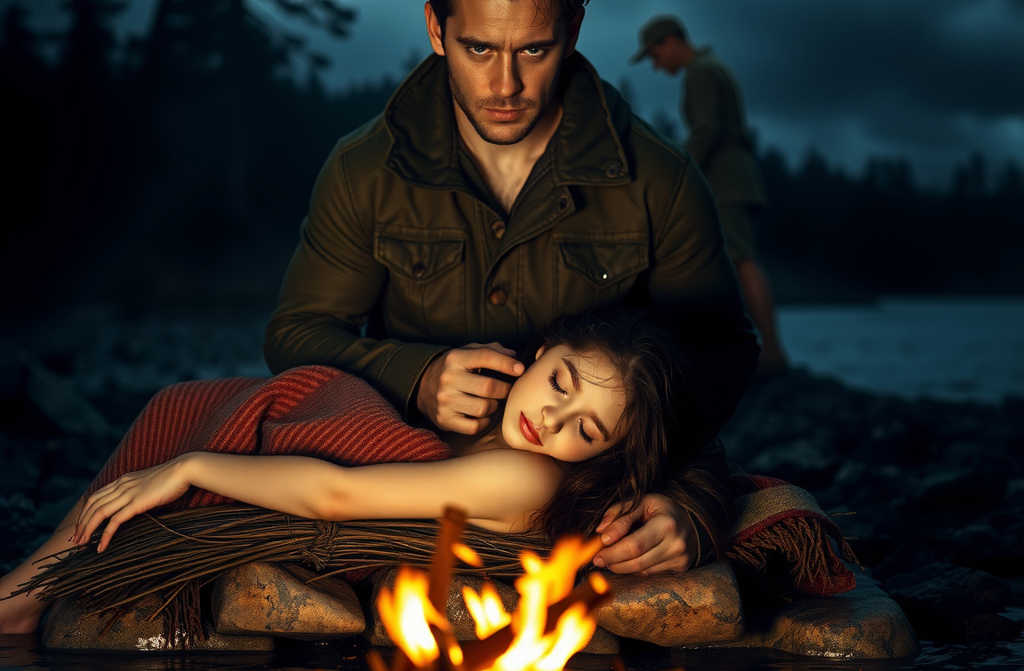
When we finally hauled the girl ashore, exhaustion fell away and duty took over. My calloused handsused to hard labour moved swiftly: turning the girl onto her back, applying pressure, performing mouthtomouth. Murky river water burst from her lungs, and a harsh, broken cough followed. Her breathing, weak but steady, returned. First, I needed to warm her. I gathered the dying embers of an old campfire, built a makeshift platform of flat river stones, layered it with a thick blanket of soft pine boughs, and gently laid her upon it. I covered her with my only remaining coat, still scented with smoke and sweat. I gathered the scattered belongings, wrestled the soaked clothing onto her stiffening frame, and settled by the new fire, stretching my trembling, frostnipped hands toward its warmth.
Heat crept in reluctantly, as if reluctant to penetrate my frozen flesh. The girl lay motionless; only a faint breath rose as a pale puff, confirming she was still alive. The cold water and the shock had done their work, but I knewjust as I knew every twist of this riverthat time would bring her back to consciousness.
I lifted my gaze to the sky, a ceiling of low, heavy clouds. Not even a sliver of moon could pierce that leaden veil. The world felt empty and bleak.
Looking down at the dancing flames, my thoughts drifted back to that merciless grey evening that had taken everything from me.
It was the summer we had taken Ethel, little Arthur, and our battered rowboat out for a fishing weekend, as we did almost every year. Leaving my wife and son to unpack the gear in the tent, I pushed off from the bank in our trusty, albeit ageing, skiff.
Warm yourself with a cuppa, Ill be back with a decent haul, and well have the best fish soup in the country! I called cheerfully to Ethel, my face breaking into an untroubled grin.
Just be careful, Victor, the weathers turning, she warned, watching the gathering clouds.
I know every stone in this stretch! Dont worry! I shouted back, oars slicing the mirrorsmooth water.
I dropped my lines into the familiar, ritualistic quiet, waiting for the bite. Suddenly the sky blackened as if night had fallen early. A fierce gale bent the ancient trees to the ground, and a wall of water surged from the heavens. The boat spun, was carried sideways, and then a deafening snap echoed as the hull struck a hidden submerged log, jutting up like a dagger. Air hissed out with a sharp, acrid smell, and in an instant the boat turned into a ragged sheet of rubber.
I tried to swim, but a searing cramp seized my leg, the icy water burning through my muscles. The rivers current overpowered me; I slammed into something hard and darkness swallowed my consciousness. When I awoke, three days later, I lay on a hard, strawfilled pallet inside a cabin that smelled of smoke and herbs. The mere act of sitting sent waves of dizziness and nausea through me. At that moment, an ancient man with a face mapped in wrinkleslike the bark of an old oakshuffled in, his feet thudding on the floorboards.
Come to, lad, he muttered, setting a steaming bowl of broth on a cracked table. Drink this herbal tea; itll staunch the bleeding. Have some porridge, or youll waste away.
Where am I? I croaked, hearing a name for a distant, unknown county and realizing Id been carried dozensif not hundredsof kilometres from home.
Rough night, lad, the old man said after a pause. A few hunters dragged me here, thought you were dead.
I tried to rise again, but he waved a withered finger at me:
Stay down, dont be a hero. Youve lost too much blood. Moving now would just bring death. Rest.
What about my family? My wife, my son theyll think Im dead! My voice cracked with desperation. I imagined Ethels face, and my heart clenched in a painful knot.
Theres no post office here, he sneered. Just forest, wolves howling, bears roaring. Its a wild place.
How do you survive out here? I asked, genuine curiosity breaking through the fear.
By the landherbs, mushrooms, nuts, berries. In winter we store supplies. Occasionally hunters swing by with a few gifts. Thats how Ive lived these twenty years. He sighed heavily, shuffled back onto his pallet, and fell asleep.
The fires dim glow flickered on the wall, casting shadows that seemed to form Ethels and Arthurs faces. A sharp ache seized my teeth as I tried not to howl. Outside, the blizzard howled, swallowing every path and hope.
Days merged into one another like knots on a rope. Each small movementturning my head, sitting up, lifting a spoonfelt like a triumph, a sliver of joy in a sea of despair.
When I finally could stand, as the old man had predicted, I took a hesitant step beyond the door. The world was transformedeverything was blanketed in a blinding, untouched sheet of snow.
How do I get out of here? I asked the hermit, trying to keep panic from my voice.
Theres no way, he replied curtly. You cant walk, and the road to the main track is a days trek, maybe more. The paths are buried. Youll have to wait for spring. If you recover, Ill show you the way.
What about the hunters? Can they help?
The hunters are out in other fields in winter. They come in spring and autumn. Maybe someone will notice if luck is on your side, but the areas too tangled now. He shook his grey head and threw another log onto the stove.
I shivered, surfacing from the flood of memories. My heart clenched with the same old pain. I stoked the fire with a few dry twigs, rose, and approached the girl. Her breathing grew deeper, steadier, though her mind had not yet returned. I adjusted her coat and returned to the fire, letting the past pull me back into its relentless whirl.
The hermit remained silent. As I grew stronger enough to move around the cabin, he began to help: clearing snow from the doorway, fetching firewood, splitting logs, keeping the stove alight. The simple broth made from vague roots and herbs no longer disgusted mehunger and survival instinct outweighed revulsion. The tea he brewed from summergathered herbs reminded me of Ethel; she used to add mint and sage to her tea. Those memories were both sweet and bitter, like a wound that never quite heals.
Winter stretched on endlessly, as if time had frozen in a glass cage. Spring finally whispered its arrival; the snow in the deep woodland melted grudgingly, inch by inch. After two more months of the tugofwar between frost and thaw, I felt strength return to my legs. The hermit, now too weak to rise, whispered:
I cant take you to the town as we promised. Im lying here myself. I need to tend to my own wounds.
How will you survive alone? Ill go to the citythere are doctors, a hospital!
No doctors here would fix you the way I have, he replied, shaking his feeble hand. Weve kept you alive with bandages and herbs. Go. Ill mend myself in time.
He gave me directions, and I, grateful beyond words, set off. The route that had seemed straight on the map turned into a chaotic maze within hours. I walked until darkness fell, still unable to locate any path. I spent the night beneath the low branches of a pine, waking to a soft, creeping rustle behind me. Turning, I sawhalfglimmering in the gloomseveral pairs of glowing green eyes: wolves. Without hesitation, I scrambled up the nearest tall spruce, clinging to its rough bark until dawn, nails digging into the wood. The pack, sensing the futility of the chase, slipped away deep into the night. I considered the descent a certain death.
Morning found me trembling, and I trudged on, hope a dim ember. Days passed; encounters with a wild boar, a lynx perched on a branch, became routine. Nights in trees turned from luxury to necessity. I lived on what I could scavengelast years berries, roots, sips from forest streams, and brief rests, ears tuned to every crackle. Yet surrender never entered my mind. I had to get back to my family, alive.
Two weeks later, in a clearing of twisted trunks, I spotted a dark rectangle: an old hunters hut, its rusted door barely moving. I crept inside, nearly fainting from exhaustion, and relief flooded me like a hot spring. Inside lay dust, dry pine needles, and the faint smell of mouse. A single grimy window held a wide wooden bed with a thin mattress, and a rolled sheepskin lay beside it. On the table rested a cloth sack of salt, a box of matches, a halffilled bag of oats, and a tin mug.
I slipped outside, gathered brushwood, and found a small clearing where I built a fire. I boiled water from a nearby brook in a tin can, steeped dried currant leaves and mint Id found in the hut, and for the first time in months tasted a hot, fragrant drink. It was almost happiness. I barricaded the door with a sturdy branch and curled into the dry sheepskin for the first restful sleep in months.
A bears roar ripped through the night, close enough to make my heart pound. Though terrified, the solid larch walls gave a hardwon sense of safety. I knew I could not remain wandering the unfamiliar woods; it would be suicide. The hut offered shelter, some food, and a modicum of security. I resolved to stay, to wait out the winter, and to return home laterbetter than never returning at all.
Matches were scarce; I learned to coax flame from a flint, dried mushrooms and berries over the stove, and gathered medicinal herbs, recalling the hermits teachings. Weeks turned into a month, perhaps more. One crisp dawn, distant gunshots and barking dogs pierced the silence. I leapt from the hut in my thin shirt, sprinting toward the sound, coughing and stumbling over roots.
Voices answered from afar. After what felt like an eternity, four hunters emerged from the trees, their rifles lowered, faces lit by the early light. I had finally been rescued. The journey back to my hometown took over a day on borrowed rides, sleep a luxury I could scarcely afford, my fists clenched in nervous anticipation.
I arrived at the familiar doorway of the rented flat I once shared with Ethel and Arthur. My heart hammered, ready to burst. I knocked. The door opened to a man in a stretchedout homet-shirtan unfamiliar face.
He told me hed been living there for three months; the previous tenants had left immediately after the husband drowned. The word hit me like a verdict, a cold iron hammer on the skull. Drowned. It meant Ethel now believed I was dead
What now? Where do I go? How do I live? The world swirled. I wandered aimlessly until I found myself at the local police station. Stammering, I recounted everything. An officer took my statement, shrugged, and promised to help locate my family.
Give me all the detailsyour wifes name, sons name, any relatives, friends, he said. Well look.
Later I went to the warehouse where I had worked before the tragedy. The gates were chained, a new corporate logo hung on the brick.
They moved, the caretaker muttered, sweeping rubbish. New address, I dont know where.
The city felt alien, indifferent. My last hope rested on an old schoolfriend, Stephen. I hurried to his house; the door swung open to reveal a woman I didnt recogniseNatasha, Stephens current partner. Her expression hardened.
Were divorced. He moved away with his new life. I have no idea about Ethel.
A few other acquaintances were scattered: one lived with his inlaws in a cramped flat, another was on a sixmonth overseas assignment. Money was scant; none could take me in.
Ethel had been a solitary woman, a gifted knitter who made exquisite sweaters and hats for clients I never met. I had no connection to her customers.
The police kept pushing me back, offering the same tired answer: Were still looking. Their time felt like a stuck record.
I finally obtained a temporary ID after a month and began hunting for work. By the riverside, as Id done for years, men in overalls gathered, waiting for a truck. I stood on the fringe.
A battered van rumbled in; a head popped out from the window, wearing a flat cap.
Builders needed? Three of em? he barked. A handful of men lunged for the vehicle, piled into the back, and the engine roared away.
Another driver offered a job with board and lodging. I eyed his weatherworn faceanother lost souland accepted. We drove to a derelict industrial site on the outskirts of town. A massive, halfcollapsed warehouse loomed, reeking of chemicals, cheap spirits, and mould.
The work was simple and disgusting: pouring a foulsmelling petroleumbased oil from drums into bottles, capping them, sticking counterfeit labels, and boxing the lot. We slept on the same pallets we packed. FoodAs the sunrise painted the sky gold, Victor slipped quietly away from the warehouse, his heart steady with the resolve to finally reunite with his family.