
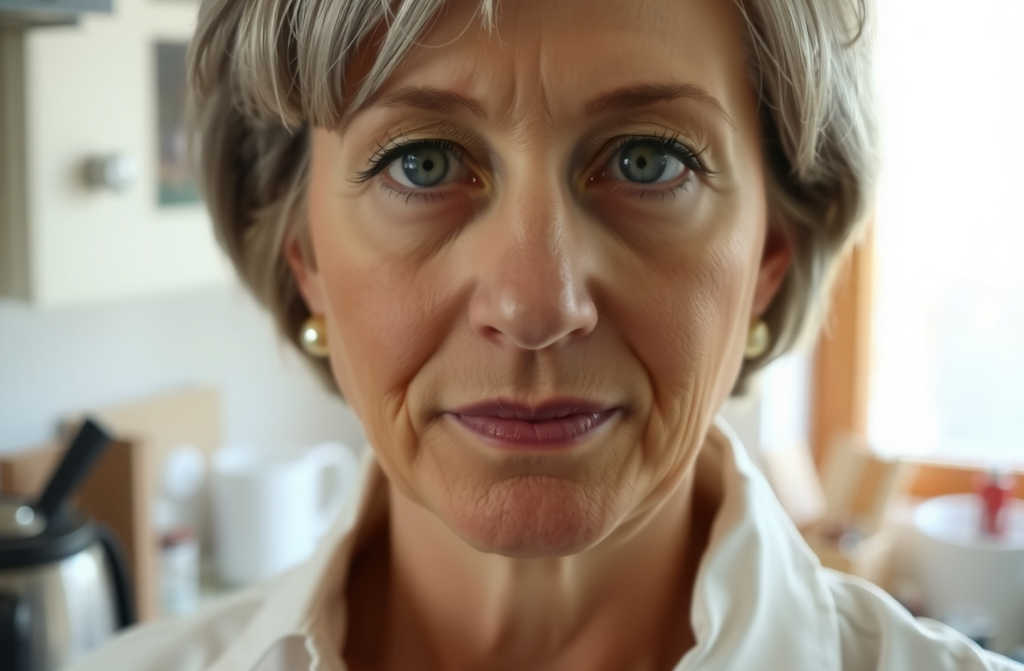
“I can’t keep living with a pensioner,” I said, my voice flat, while Victor stared not at me but at the plate of meatballs in front of him. I’d just set the second one down for him—he’d been eating two every Saturday for thirty‑two years, without fail.
“What are you talking about, Victor?” I asked.
“About us, Eleanor. More precisely, about the fact that we’re no longer a thing.”
I sat opposite him, palms flat on the table, trying not to give anything away. My accountant brain switched on before the wife instinct. The word “no” always triggers the ledger first.
“You’re leaving?”
“I am. I’ve found someone else. She’s twenty‑nine, and, you know, she doesn’t traipse around the flat in a night‑gown with empty pockets.”
My own night‑gown was indeed an old blue one, buttoned across the chest, bought back when our daughter started school. It was comfortable; Victor used to call it “my sofa” and laugh. Now there was no laughter.
“What’s her name?” I asked, nodding as if that would explain anything.
“Christina.”
I nodded, as if the name itself could settle the balance sheet of my life.
The meatballs cooled on the table. I stared at them, remembering that I’d spent three hours shaping them—grinding the mince myself, soaking the breadcrumbs in milk just as my mother had taught me. Three hours of my Saturday ritual, and now he was going to stand up and walk off to Christina, who was probably ordering sushi.
“When?”
“What do you mean ‘when’?”
“When are you leaving?”
“Today. I’ve already packed my bag.”
Something clicked inside me—not a snap, not a break, but a switch being flipped. He had his bag packed while I was still in the kitchen, still stirring a pot of stew for the week ahead like a fool.
“Fine, go,” I said.
He raised an eyebrow, as if I’d just told him the sky was blue.
“Is that all? No more words?”
“What do you expect me to say, Eleanor? That I’ve wasted thirty‑two years washing your shirts for nothing? I already know that without you.”
He stood and drifted into the hallway. I heard him fiddling with the lock on the suitcase—the very one we’d taken to Brighton in 2008 when we got the bonus that bought us the flat. I’d even put Mum’s inheritance in there: two million seven hundred thousand pounds. I remember every figure—my accountant brain never forgets.
We’d put the property in his name. “It’ll be easier, love, we’ll transfer it later.” We never did.
I sat at the kitchen table, staring at his two meatballs, then rose, grabbed a huge black bin bag—one that held a hundred and twenty litres, the kind I used to collect Tesco waste in batches—and headed for the bedroom.
“What are you doing?” he asked, seeing the bag.
“Helping you pack. One suitcase won’t be enough.”
I started dumping everything in: shirts, training trousers he’d worn on Sundays on the sofa, slippers, toothbrush, razor, phone charger. All into the bag, quick and calm, like a stock‑take.
“Eleanor, you’ve gone mad.”
“No, Victor. I’ve finally gone sane. First time in thirty‑two years.”
He seized my wrist. I looked at his short fingers, yellowed nails, and he let go for some reason.
“I’ll come back for the rest later.”
“Come back. Call ahead so I can open the door.”
I still thought I’d open it.
Four days later he arrived—not alone.
I opened the door and saw her: Christina, standing on the doorstep in a white coat completely out of season, a thin chain‑strap bag hanging from her shoulder, looking at me the way you stare at an old settee that needs to be taken away.
“Good afternoon,” she said politely, with a slight squint.
“Good afternoon,” I replied.
Victor slipped past me into the hall, still acting as if he owned the place.
“Eleanor, we’ll be quick. I need the winter clothes and the documents.”
“What documents?”
“My passport, the car registration, my National Insurance number, and the papers for the flat.”
I halted in the kitchen doorway.
“The flat?”
“Yes, the flat is still in my name.”
Christina gave a tiny smile at the corner of her mouth. I’d remember that smile.
“Victor,” I said very slowly, “are you seriously coming to collect the documents for the flat I poured Mum’s inheritance into?”
“What inheritance? That was a hundred years ago,” he muttered.
“Eighteen,” I corrected. “Eighteen years ago. Two million seven hundred thousand pounds in 2008—roughly the market price of a two‑bedroom in our neighbourhood back then. You laughed then, calling it ‘a penny saved is a penny earned.’”
“Young man,” Christina interjected suddenly, “we don’t have time for this.”
The phrase “young man” hit me like a slap. He was fifty‑six, belly over the belt, face flushed, dark circles under his eyes—hardly a youngster. But to her he was ‘young’ because he paid. And he’d been paying, of course, with my money; the last three years he’d been sending half my salary to the bank for “fuel and meals.”
A sharp crack rang in my temples—not my heart, but the very bones of my skull, as if someone had snapped a finger inside my head.
“Victor, please step out and take your lady with you. I’ll get the documents through the courts.”
“What?”
“Through the courts, Victor. From now on I’ll give you everything—shirts, socks, the half of the flat that you supposedly own—by court order, stamped and signed.”
Christina snorted. “Do you really think you’ll win that? The flat is in his name.”
“Miss,” I turned to her, and something in my tone made her step back, “go into the hallway. I’m speaking with my husband. Formally, he’s still mine.”
Victor tugged at her sleeve; she slipped out onto the stairwell. He stayed.
“Eleanor, don’t do anything foolish. We can work this out.”
“We can,” I said, “but ‘working it out’ isn’t ‘hand over the flat and the passport.’ Working it out is ‘let’s calculate who put in what and split it.’ Shall we calculate?”
He stayed silent.
“Don’t want to calculate? Fine. I’ll do it myself. I’m good at that.”
I closed the door behind him, turned the lock twice, and leaned against it.
The flat was quiet, the refrigerator humming, the lingering scent of the stew I’d never finished from Saturday.
I slid down the door onto the floor and sat for five minutes, not crying, just counting in my head: two million seven hundred plus the 2012 renovation—four hundred, plus the kitchen in 2015—two hundred ten, plus the balcony in 2019…
My accountant side was at work; the wife part was mute.
Later I called a locksmith. He arrived an hour later and replaced the deadbolt for £23. I logged the expense in my little notebook—old habit.
That evening my daughter called.
“ Mum, Dad says you’re not letting him in.”
“I’m not.”
“ Mum, how can that be? He’s—”
“Alison, one thing—don’t interfere. Please. I’ll handle it.”
She fell silent, then said, “Alright, Mum.”
That simple ‘alright’ was the first thing that warmed me that week.
Two weeks later a summons arrived: “Claim for division of jointly acquired assets.” Victor demanded half the flat, half the cottage (which we didn’t own—he’d just written it in for show), and an odd “moral damage” compensation for changing the locks.
I read it and, honestly, laughed—for the first time in a month.
I went to a solicitor— not a friend, because friends talk too much, but a stranger advertised online. A woman in her forties, grey blazer, introduced herself as Irene Clarke.
I laid out the file I’d been building for eighteen years. My habit of keeping everything.
“Inheritance certificate from 2007,” I said, handing over paper after paper. “Bank statement showing the two million seven hundred thousand deposit. Sale agreement for the flat at that price, month after month. Receipts for the 2012 renovation, kitchen in 2015, balcony in 2019. Utility bills—paid from my salary of £58,000 a year for the last six years while he pretended to ‘invest in the relationship.’”
Irene flipped through the stack, then looked up.
“Eleanor, why have you kept all this?”
“I’m an accountant. I keep records.”
She smiled, the kind of smile you give when you meet someone who shows up with nothing but documents.
“You have a very strong position. I think we can get you not just half, but the whole lot.”
I nodded, then added, “One more thing, Irene. I’m his guarantor on a car loan—Toyota, taken out in 2022 for three years, eleven months left. Can I get out of that?”
She thought a moment.
“You can’t release the guarantee unilaterally, but you can inform the bank of a material change—divorce. The bank will likely demand a new guarantor or early repayment. If he can’t find either…”
“Will they repossess the car?”
“They will.”
I looked out the window at wet snow melting on the eaves, imagined Christina in her white coat, perhaps loving that very Toyota. I remembered Victor taking me to the doctor’s and to the cemetery in that car.
“Let’s write to them,” I said.
Irene drafted the letter.
That night I made tea for myself—in a small, forgotten mug with forget‑me‑not pattern, the one Victor always despised—and drank it by the window.
The flat was silent. My night‑gown hung on a hook. No one called it “the sofa” any more.
I thought, maybe being alone isn’t frightening. It was terrifying to spend thirty‑two years cooking two meatballs for one man and receiving just a sliver of attention.
The phone rang. An unknown number.
“What have you done, old woman?!” Christina screamed into the receiver.
I set the phone down, handling it as carefully as an accountant separates a faulty report.
“Miss, I have a request. Please contact me only through my solicitor, Irene Clarke. I’ll give you her number.”
I hung up.
The first gunshot sounded.
The court date was in February.
Victor arrived in his only suit—a dark navy one, the same he’d worn at Alia’s wedding four years ago. It was tight around the waist, the jacket didn’t sit right.
Christina was absent; I later learned they’d quarreled that very day.
I wore a plain skirt and a white shirt—no night‑gown, of course. Victor looked at me, confused, perhaps expecting the frail pensioner. Instead, a woman who had kept another man’s books for thirty‑two years sat across from him, ready to balance her own ledger.
Irene spoke for twenty minutes, calmly, document by document: inheritance certificate, bank statement, receipts—three hundred and eighteen pages. Payments. She laid it all out.
Victor flushed, paled, even fumbled for his Vicks inhaler—only to find it missing, because I always kept it in his pocket.
The judge, after reviewing the file, asked, “Defendant, do you have anything to say?”
“This is jointly acquired property,” Victor began.
“On what funds was the flat bought?”
“On joint funds.”
“The case file shows an inheritance certificate and a bank statement. Two million seven hundred thousand pounds landed in the plaintiff’s account in 2007. The flat was purchased in 2008 for that sum. Do you have any proof of contribution?”
“No proof?”
The court ruled in my favour. The flat was mine, plus compensation for the renovations—another six hundred thousand pounds he had promised to pay within six months.
Victor was the first to leave the courtroom. I stayed to sign the paperwork.
In the corridor, he stood by the window, looking out over the courtyard. His shoulders slumped, his suit hanging like a sack.
“Eleanor,” he said without turning, “you can’t just take everything.”
“How?”
“It’s everything, down to the last penny. I’m not a stranger to you. We have a daughter together.”
I stepped closer, stood beside him, and—against all my expectations—said, “Victor, I wasn’t a stranger for thirty‑two years. I became a stranger in a single Saturday. You told me you couldn’t live with a pensioner. I’m not a pensioner; I’m fifty‑four, six years from retirement. Even if I were, I’d never forgive you for those words. Not a pound, Victor. And I’ll never forgive you for the car loan.”
“What car loan?”
“The Toyota. I’ve written to the bank about our divorce. The guarantee is off me. They’ll call you soon, demand early repayment or a new guarantor. Do you think Christina will stand in?”
He turned, his face white, not flushed.
“Did you… did you do this on purpose?”
“Very much on purpose.”
I walked past him toward the lift.
A second gunshot rang in the courtroom corridor. I heard Victor’s phone buzz—probably the bank.
Back home I poured tea into that forget‑me‑not mug, sat by the window, watching the snow, thinking that perhaps this was what people mean when they say “justice has been served.”
My hands trembled—not from fear, but from the fatigue of thirty‑two years finally allowed to surface.
Then Alia called.
“Mum, have you gone mad? Dad’s lost his car. He says you set him up with the bank. Is that true?”
“The truth, dear.”
“Dad’s my father. He’s crying.”
“Alia, I love you, but we’re closing that chapter. He’s been my husband, not any longer. I have my own accounts now, he has his.”
She was silent, then said, “You’ve changed.”
“I’ve become myself, Alia. For the first time in thirty‑two years.”
Another shot rang. The second. I didn’t know whether to rejoice; Alia was sobbing on the line.
A year passed.
I learned bits about Victor through Alia’s occasional calls—by then she’d stopped calling him “dad” and started saying “him.” He’d lost the Toyota in March; Christina refused to be a guarantor, saying she wasn’t there to pay his debts. They never married, living in a one‑bed flat on the outskirts, each month sinking deeper.
In August she finally threw him out.
It happened on a Wednesday evening. Alia phoned, crying: “Mum, he’s calling, says he has nowhere to stay. The flat is gone, the car is gone, Christina’s thrown his bags out. He says, ‘I can’t live with a debtor any longer.’”
I was peeling potatoes, now cooking single portions, so less waste.
“Can you hear me?” she asked.
“Yes.”
“He wants to come back—temporarily.”
I looked at the potato in the bowl, my knife, my hand steady.
“Alia, tell him one thing: ‘I can’t live with a pensioner any longer.’”
“Mother!”
“It’s his words, Alia. Not mine.”
She fell silent, then whispered, “You’re cruel.”
“Maybe.”
“You should see him. He’s in an old coat, a bag of his things, looking like a vagrant.”
“I’ve seen him for thirty‑two years, Alia. In fine suits, in training tracksuits. Now it’s my turn to live, not watch him with a bag.”
She hung up. I finished the potatoes, turned the stove on, and cranked up the television—loud, as I hadn’t in ages, because Victor hated the noise.
A drama flickered on, but I wasn’t watching; I was listening to the voices that now filled my flat, completely, from wall to wall.
Two hours later my phone buzzed on the table. Victor’s number. It vibrated, slid to the edge. One ring, two, three… I didn’t answer. Not the fourth, not the fifth, not the sixth—he called six times before midnight. I counted, as any accountant would.
The next day Alia messaged, “He’s staying over for a night. Temporary.” I replied, “Alright, love, take care of yourself.” And that was it.
We never speak of it again. Alia is distant; the neighbour, Aunt Vera, said in the lift, “Eleanor, forgive him, he’s a man, men do what they do.” My coworker, the accountant, said, “Eleanor, the daughter’s torn, she’s breaking apart.” My sister from Coventry whispered, “Eleanor, he’s on the streets, give him something for winter.”
I haven’t.
Did I do the right thing with the bank and the guarantee? Or was I right to hold onto the thirty‑two years of laundry, two meatballs, and the ‘pensioner’ label?
What would you have done, ladies? Would you let a husband back in, the same manShe lifted her tea mug, looked out at the quiet street, and whispered to the empty room that, at last, she was finally her own master.