
I’ll never forget that frosty December night when my phone rang, and my daughter’s voice burst into tears. “Mum, I’m in over my head… I can’t keep going, I don’t want to leave Tom, but I have to work… Please help me,” she sobbed.
Emily’s tone was ragged, as if she’d finally realized how frightening adulthood could be. At twenty‑three, newly single after a break‑up with Tom, she was trying to piece her life together: finish her degree, land a job, rent a flat in Manchester. Every week, however, her hopes melted faster than the snow outside her flat in York.
I remember glancing at my sleeping grandson. He was only two, with wispy blond hair, rosy cheeks, and a steady breath that suggested he hadn’t yet discovered how bewildering grown‑up life could be.
I didn’t hesitate. I pulled Emily into a hug and promised her I’d look after Charlie as best I could. “Just a short stint, love. I need to get my bearings, spread my wings. I’ll take him back as soon as I’m on my feet,” she assured.
What was supposed to be a brief pause stretched into months, then years. In the first few weeks Emily called daily, rattling off work updates, asking whether Charlie was babbling new words, feeding himself with the spoon, or sleeping soundly. Occasionally she’d break down into the receiver, and I’d soothe her with the reminder that my grandson was happy and had everything he needed.
Gradually the calls grew sparse, silence replaced the routine questions. Charlie blossomed into a bright, sensitive little lad. I taught him colours, walked him to nursery, cheered him on at his first school sports day. He’d tug at my sleeve with night‑time nightmares, cuddle up at dawn for a hug. I was his everything—grandmother, mother‑figure, confidante. I didn’t worry about whether I was doing it right; I simply knew I loved him and would give him the world.
Emily sent Christmas cards, popped over a few times a year. I could sense a distance, a hint of regret hidden beneath polite smiles. Yet she always repeated that she couldn’t manage without my help and that one day she’d repay the favour.
Seven years slipped by. Charlie kept growing, and I increasingly realised that the temporary arrangement had become our new normal. We forged our own little rituals: bedtime story marathons, joint baking sessions, long Sunday walks in the park. Sometimes I felt a pang seeing his mother only on weekends and holidays, but I reminded myself, “She’s doing this for him—working so he has a better future.”
Then, out of the blue, Emily’s voice changed. It was firmer, more decisive, as if she’d finally gotten her act together. “Mum, I’m coming this weekend. We need to talk,” she said. A nervous flutter rose in my chest, though I couldn’t name it.
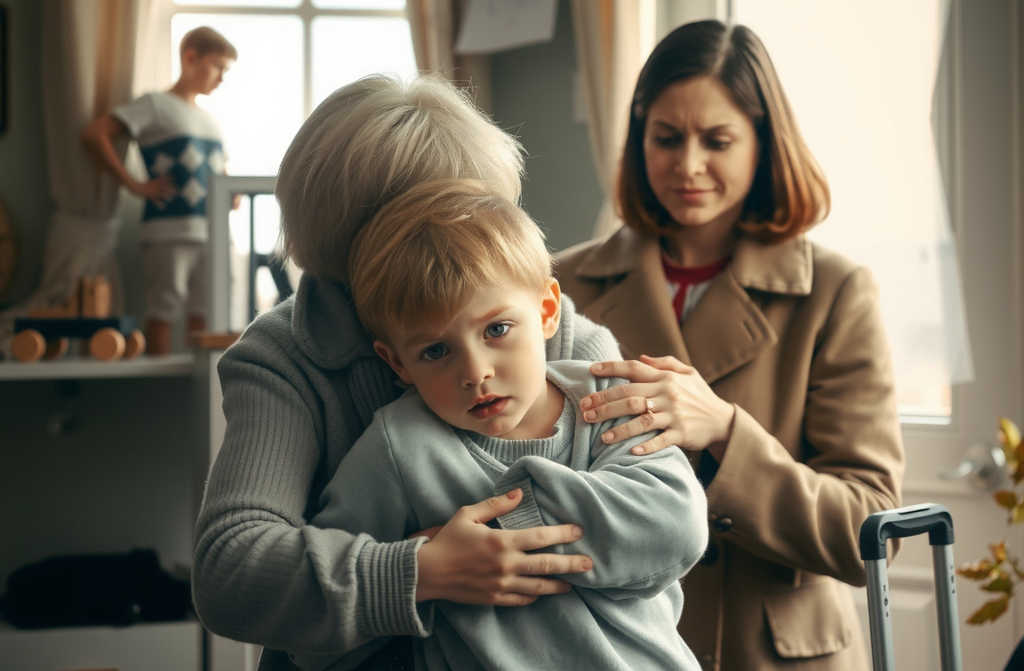
She arrived Saturday morning, looking markedly different—confident, well‑kept, a spark in her eyes. “Mum, I’m taking Charlie to live with me. I’ve got a flat in Leeds, a good job, and I can give him everything he needs.” It felt as if someone had ripped my heart from my ribs. I forced a smile, tried to sound proud, but inside a sharp ache settled.
Charlie, listening at the doorway, turned to me with worry in his eyes. “Grandma, I don’t want to move,” he whispered. I tried to explain that his mum loved him dearly and that spending more time together was a good thing.
Emily’s gaze grew colder. “All these years you let him think you were his mother. You’ve taken my child away,” she said quietly, then looked away.
Those words have haunted me ever since, echoing each night. I only wanted to help. I loved Charlie as if he were my own son, never intending to replace his mother. I replay the what‑ifs: could I have stepped back more, encouraged their contact, let Emily lead? Maybe I should have enjoyed my moments with Charlie without constantly reminding him who his real mum was.
Now Charlie lives with Emily. I see him less often, yet whenever he shows up at my door he darts into my arms as if no time has passed. When the door shuts behind him, I’m left with a hollow that no other sound can fill.
I peek into his old bedroom; the favourite wooden car still sits on the shelf, and under his pillow I once found a crayon drawing that read, “Love you, Gran.” Some evenings I sit there, thumbing through his picture books, hearing his giggle in my head.
Emily’s calls have become brief and business‑like. When I ask how they’re doing, she says all is well, but there’s a distance in her tone, as if the closeness we once had is now a memory. Occasionally I glimpse her through the kitchen window as she drops Charlie off—tired, yet content. I try to trust that she’s made the right choice, that her son finally has a mother by his side.
At night I wake with a knot of doubt: did I do something wrong? Should I have fought harder, begged for more talks? Or perhaps the toughest thing I ever did was to let go—accept that their world now belongs to them, while I remain a fond footnote to their story.
One thing I know for sure: my love for Charlie will never fade. I’ll keep waiting for the day he bursts through my door, shares his triumphs and troubles, and once again rests his head on my knee as he used to.
Whether Emily ever fully forgives me or we ever regain the closeness of old is uncertain, but I trust that someday she’ll understand just how much of my heart I gave away trying to shield them both from loneliness.
Sometimes the greatest love is the one you set free, even if it hurts more than anything else in the world.